The Who's Who in the
BC Fentanyl Epidemic
An evidence deck and language database mapping the players, policies, and public record.
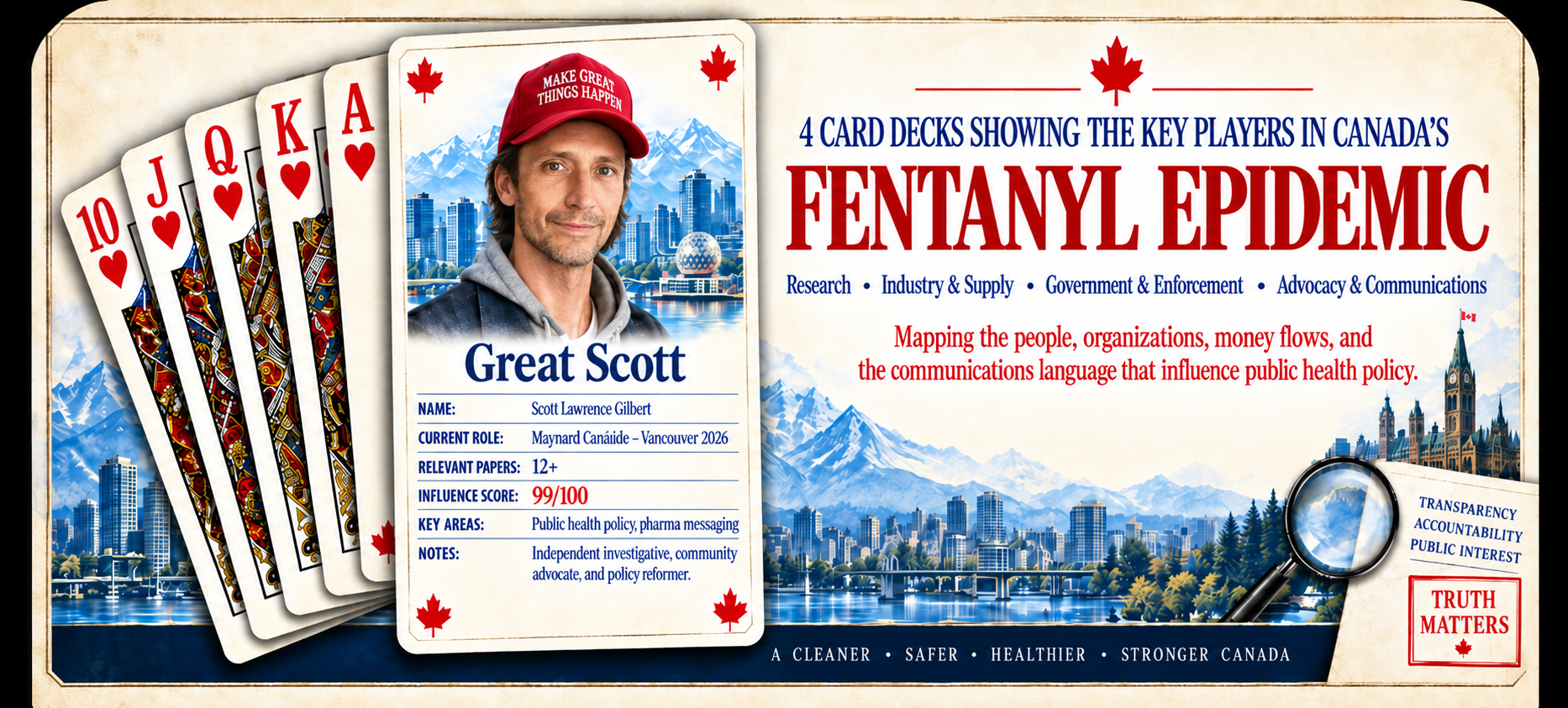
The Evidence Deck and Fentanyl Language Database is a public-interest research project mapping the people, institutions, policies, publications, companies, government decisions, policing practices, funding relationships and terminology that shaped the fentanyl crisis in Vancouver and Canada from the late 1990s to the present.
The project converts a large documentary record into an accessible deck of cards, with each card representing a person, organization, policy, publication, event or unresolved research question and linking back to the underlying evidence.
Alongside it, the Fentanyl Language Database tracks how influential terms, statistics and claims — including safe supply, harm reduction, toxic drug supply, diversion, prescribed alternatives, overdose prevention, and decriminalization — emerged, changed meaning and moved between academic research, government, policing, health agencies, pharmaceutical interests, advocacy organizations and the media.
A person’s inclusion in the project does not imply misconduct, responsibility for the overdose crisis, or association with every other person in the database.
The objective is to make complicated relationships, competing claims and unanswered questions easier for the public to examine, challenge and independently verify.
The Evidence Deck & Fentanyl Language Database
The fentanyl crisis did not appear overnight. It developed over decades through changes in pharmaceutical markets, illicit drug supply, prescribing, policing, public-health policy, addiction medicine, academic research, government funding, advocacy, regulation and public language. Thousands of documents describe pieces of that history, but the information is scattered across government records, scientific papers, court decisions, lobbying disclosures, corporate records, news reports, freedom-of-information releases and institutional archives.
The Evidence Deck is an attempt to put those pieces into one navigable research system.
Instead of presenting the history as a single predetermined narrative, the project creates individual cards for significant people, organizations, government bodies, companies, research projects, policies, publications, events, claims and unanswered questions. Each card can be connected to other cards through documented relationships such as employment, authorship, funding, lobbying, contracting, advisory roles, institutional affiliation, policy participation or public statements.
The accompanying Fentanyl Language Database examines something less visible but equally important: the language through which the crisis has been explained.
Terms such as harm reduction, safe supply, prescribed alternatives, toxic drug crisis, diversion, overdose prevention, treatment, recovery, decriminalization, and involuntary care can carry different meanings depending on who is using them, when they are being used and what evidence is being cited. The database will trace terminology and influential factual claims through time and identify where they first appear, how definitions change, which institutions repeat them, what research supports or contradicts them, and whether widely repeated statistics can be traced to their original evidence.
The project is designed to distinguish documented fact from inference, allegation and unanswered question.
Where possible, entries will identify the underlying source, date and nature of a relationship rather than merely asserting that two people or organizations are “connected.” Evidence can be classified by source type and reliability — for example, primary government records, peer-reviewed research, corporate filings, lobbying disclosures, court records, institutional biographies, contemporaneous journalism or unverified claims requiring additional investigation.
That distinction is fundamental.
Being included in this database is not an accusation of wrongdoing. Many people will appear simply because they conducted research, held public office, worked for an organization, published an influential paper, participated in a policy process, manufactured or distributed a relevant pharmaceutical product, enforced drug laws, advocated for a particular policy, or were otherwise part of the documented history being examined.
Likewise, a connection between two cards does not by itself establish collusion, improper influence or shared responsibility. A co-authorship is a co-authorship. Employment is employment. Funding is funding. Lobbying is lobbying. The project should show what the evidence establishes and allow readers to decide what significance, if any, those relationships deserve.
The database will also deliberately preserve unknowns. If historical records indicate that a company retained public-relations representatives, sales personnel, consultants or government-relations professionals but the available record does not yet identify them, the project may create an unresolved research placeholder rather than guessing at a person’s identity. As additional records become available, those gaps can be investigated and corrected.
The longer-term objective is to create a structured historical record covering the emergence of fentanyl and other synthetic opioids in Canada, pharmaceutical opioid policy, prescribing practices, law-enforcement responses, Vancouver’s Downtown Eastside, supervised consumption, overdose prevention, treatment and detoxification policy, prescribed alternatives, drug-user advocacy, academic research networks, government decision-making and the evolution of the illicit market.
The project is also intended to be challengeable.
Researchers, journalists, public officials, clinicians, organizations and individuals appearing in the database will be invited to identify errors, provide missing records, dispute classifications and supply additional context. Substantive corrections should become part of the public record rather than disappearing silently. Where evidence is contested, the database should preserve the competing evidence and explain the dispute.
Ultimately, the Evidence Deck is not supposed to tell the public whom to trust. It is intended to make the evidence easier to inspect.
If a policy succeeded, the evidence should be visible. If a prediction failed, that should be visible too. If a frequently repeated claim originated from strong research, readers should be able to find it. If it originated from weak evidence and was repeated until it became conventional wisdom, the historical record should make that traceable as well.
The governing principle is simple: show the source, show the relationship, separate evidence from interpretation, and leave a documented path for correction.
If You Appear in the Evidence Deck
Your inclusion in the Evidence Deck does not mean that this project is accusing you of misconduct.
This is a historical and public-interest research database examining the development of fentanyl, opioid policy, addiction treatment, harm reduction, drug enforcement, pharmaceutical activity and related public policy in Vancouver and Canada.
People and organizations may be included because they authored research, held a relevant position, received or provided funding, participated in government decision-making, represented an organization, manufactured or distributed a relevant product, lobbied government, provided medical services, advocated for a policy, enforced drug laws, appeared in public records, or otherwise form part of the documented history.
A connection displayed between people or organizations should be read according to the specific relationship identified and the evidence supporting it. Inclusion, proximity on a diagram, institutional affiliation, funding, employment, co-authorship or participation in the same policy process does not by itself establish wrongdoing, coordination or improper influence.
We want the database to become more accurate as it develops.
If a profile about you contains an error, lacks important context, attributes a statement incorrectly, mischaracterizes a relationship, relies on a source you believe is unreliable, or omits evidence that materially changes the record, we want to hear from you.
You are invited to provide:
- corrections of factual errors;
- primary documents or stronger sources;
- explanations of your role or involvement;
- relevant publications or statements;
- clarification of relationships shown in the database;
- evidence disputing a claim or interpretation;
- disclosure of potential conflicts or interests that should be included; and
- additional people, organizations, records or events that should be examined.
Corrections supported by reliable evidence will be incorporated. Where there is a genuine disagreement about interpretation, the project may present both the original evidence and the response so readers can evaluate the issue themselves.
The purpose of this project is not to create guilt by association or to publish rumours as facts. Its purpose is to build a transparent, source-based record of how one of Canada’s most consequential public-health and public-policy crises developed.
If we have something wrong, help us correct it. If an important part of the history is missing, help us find it. And if the evidence supports what we have reported, readers should be able to inspect that evidence for themselves.
To submit a correction, supporting evidence or clarification, email greatscott@draintheswamp.ca. Please identify the relevant person, organization or card, describe the correction or clarification, and attach supporting documents or include links to sources. The link opens your email app; you can also copy the address into your email service.